
Empathy Lab to międzynarodowy projekt realizowany przez Fundację Leonarda we współpracy z organizacjami partnerskimi z Włoch i Hiszpanii w ramach programu Erasmus+ Small-scale Partnerships in Youth (KA210-YOU). Projekt potrwa od października 2025 do marca 2027 roku i koncentruje się na rozwijaniu empatii, przeciwdziałaniu dyskryminacji oraz wzmacnianiu edukacji o prawach człowieka wśród młodych ludzi.
Projekt rozpoczął się 1 października 2025 roku i potrwa do 31 marca 2027 roku. Przez 18 miesięcy wspólnie tworzymy narzędzia, materiały i przestrzenie edukacyjne, które mają pomagać młodym ludziom oraz osobom pracującym z młodzieżą rozwijać empatię, lepiej rozumieć mechanizmy dyskryminacji i świadomie reagować na stereotypy, uprzedzenia oraz dezinformację.
Empathy Lab łączy edukację o prawach człowieka, edukację antydyskryminacyjną, rozwijanie empatii, krytyczne myślenie i storytelling. Szczególną uwagę poświęcamy młodym osobom mieszkającym w mniejszych miejscowościach i na obszarach bardziej oddalonych od dużych ośrodków.
Dlaczego Empathy Lab?
Żyjemy w rzeczywistości, w której dostęp do informacji jest właściwie nieograniczony, ale nie oznacza to automatycznie, że łatwiej jest nam rozumieć siebie nawzajem. Dezinformacja, stereotypy, uproszczone przekazy dotyczące różnych grup społecznych i rosnąca polaryzacja mogą sprawiać, że zamiast dialogu pojawia się dystans, nieufność, a czasem również otwarta wrogość.
Szczególnie młode osoby z mniejszych miejscowości mogą mieć mniej możliwości bezpośredniego kontaktu z osobami reprezentującymi inne kultury, doświadczenia czy style życia. Wiedza o różnorodności bywa wtedy budowana przede wszystkim na podstawie mediów, internetu i przekazów funkcjonujących w najbliższym otoczeniu – a te nie zawsze pokazują pełny obraz rzeczywistości.
Dlatego w Empathy Lab chcemy łączyć wiedzę z doświadczeniem. Z jednej strony mówimy o prawach człowieka, dyskryminacji, stereotypach i dezinformacji, z drugiej – szukamy takich metod edukacyjnych, które pozwalają na chwilę zmienić perspektywę, usłyszeć historię innej osoby i zastanowić się nad własnymi przekonaniami.
Empatia nie oznacza, że musimy się ze wszystkimi zgadzać. Oznacza natomiast gotowość do próby zrozumienia doświadczenia drugiego człowieka. I właśnie tę kompetencję chcemy rozwijać.
Co chcemy osiągnąć?
W ramach Empathy Lab chcemy przede wszystkim:
- rozwijać empatię jako praktyczne narzędzie przeciwdziałania dyskryminacji, nietolerancji i mowie nienawiści,
- zwiększać wiedzę młodych ludzi na temat praw człowieka, równego traktowania i mechanizmów dyskryminacji,
- rozwijać krytyczne myślenie i umiejętność rozpoznawania dezinformacji oraz stereotypowych przekazów,
- wspierać edukatorów, trenerów, wolontariuszy i youth workerów w prowadzeniu działań dotyczących empatii i inkluzji,
- tworzyć metody edukacyjne możliwe do wykorzystania zarówno podczas działań stacjonarnych, jak i online,
- budować współpracę między organizacjami młodzieżowymi, edukatorami, NGO i społecznościami lokalnymi w Polsce, Włoszech i Hiszpanii.
Od pomysłu do praktyki – etapy Empathy Lab
Projekt został zaplanowany jako proces, w którym kolejne działania wynikają z poprzednich. Zaczynamy od zebrania wiedzy i istniejących metod, następnie tworzymy własne narzędzia, szkolimy osoby pracujące z młodzieżą i testujemy opracowane rozwiązania, a w ostatnim etapie oddajemy więcej przestrzeni samym młodym ludziom.
Październik 2025 – marzec 2027: koordynacja i współpraca międzynarodowa
Przez cały okres realizacji projektu Fundacja Leonarda koordynuje współpracę partnerstwa. Regularnie spotykamy się online, monitorujemy postępy, dzielimy zadania, konsultujemy powstające rezultaty i wspólnie podejmujemy decyzje dotyczące kolejnych działań.
Za koordynację całego projektu odpowiada Fundacja Leonarda, natomiast szczególną rolę w monitorowaniu jakości działań i rezultatów pełni włoska organizacja LUMiA ETS.
Dzięki temu Empathy Lab nie jest zbiorem kilku niezależnych wydarzeń, ale jednym procesem realizowanym wspólnie przez organizacje z trzech krajów.
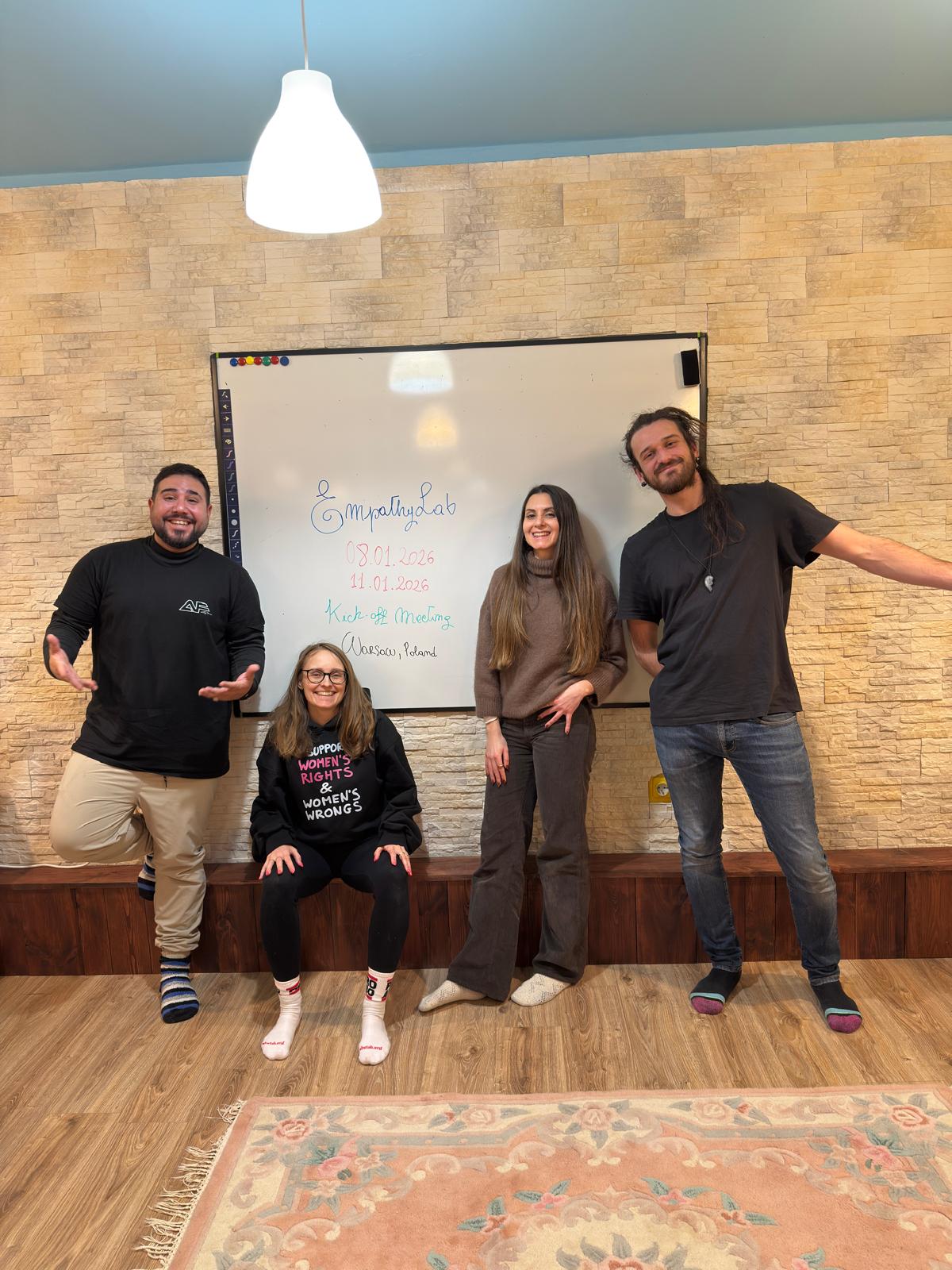
Styczeń 2026: Kick-off Meeting w Polsce
Jednym z pierwszych ważnych momentów projektu było międzynarodowe spotkanie partnerskie w Polsce w styczniu 2026 roku.
Przedstawiciele Fundacji Leonarda, LUMiA ETS oraz YEP spotkali się, aby szczegółowo omówić harmonogram projektu, podział obowiązków, sposób komunikacji i monitorowania rezultatów.
Był to też moment na rozmowę o tym, jak rozumiemy empatię i jak chcemy o niej edukować. Partnerzy reprezentują różne doświadczenia związane z edukacją pozaformalną, pracą z młodzieżą, storytellingiem, prawami człowieka czy działaniami społecznymi. Ta różnorodność jest jednym z ważniejszych zasobów projektu.
2025/2026: tworzenie bazy wiedzy
Jednym z pierwszych konkretnych rezultatów projektu jest Resource Database – baza wiedzy dotycząca praw człowieka, przeciwdziałania dyskryminacji, inkluzji i dezinformacji.
Zebraliśmy w jednym miejscu materiały, publikacje, raporty, narzędzia edukacyjne, materiały wideo oraz inne zasoby, które mogą być przydatne osobom pracującym z młodzieżą – można ją zobaczyć na dole tej strony.
Baza pozostanie dostępna również po zakończeniu projektu, dzięki czemu nie będzie jednorazowym rezultatem, ale zasobem możliwym do dalszego wykorzystywania.
Wiosna–lato 2026: od researchu do Empathy Toolkit
Kolejny etap to Research and Development of Empathy Education and Anti-Discrimination Methodologies.
Partnerzy przeanalizowali istniejące metody, publikacje i dobre praktyki dotyczące edukacji empatycznej, przeciwdziałania dyskryminacji, edukacji o prawach człowieka, pracy z różnorodnością i krytycznego myślenia.
Na podstawie zebranych materiałów powstaje jeden z głównych rezultatów całego projektu – EmpathyLab Toolkit.
Obecnie mamy już jego roboczą wersję, którą wspólnie przeglądamy i rozwijamy. Toolkit ma być przede wszystkim praktyczny: zamiast pozostawać wyłącznie na poziomie teorii, będzie zawierał konkretne ćwiczenia, metody i scenariusze, które można przenieść do własnej pracy z grupą.
Znajdą się w nim m.in. aktywności wykorzystujące storytelling, pracę z perspektywą, dyskusję, symulacje, case studies i metody edukacji pozaformalnej. Zależy nam również na tym, aby proponowane metody można było dostosowywać do różnych grup i kontekstów edukacyjnych.
Październik 2026: międzynarodowe szkolenie w Rimini
Kolejny krok to przejście od tworzenia materiałów do ich praktycznego wykorzystania.
Już w październiku 2026 roku w Rimini we Włoszech odbędzie się międzynarodowy kurs szkoleniowy dla osób pracujących z młodzieżą z Polski, Włoch i Hiszpanii.
Podczas szkolenia uczestnicy będą poznawać i testować metody rozwijania empatii oraz pracy z tematami związanymi z dyskryminacją, prawami człowieka i inkluzją. Ważną częścią programu będzie również tworzenie bezpiecznej przestrzeni do rozmowy o trudnych doświadczeniach, prowadzenie dyskusji, praca ze storytellingiem oraz wykorzystywanie powstającego Empathy Toolkit.
Szkolenie ma przygotować uczestników nie tylko do korzystania z gotowych materiałów, ale również do świadomego dostosowywania ich do potrzeb własnych grup.
Jesień 2026: lokalne warsztaty w Polsce, Włoszech i Hiszpanii
Po szkoleniu wiedza wróci razem z uczestnikami do ich lokalnych społeczności.
W Polsce, Włoszech i Hiszpanii odbędą się lokalne warsztaty wykorzystujące metody wypracowane w ramach Empathy Lab. Będzie to jednocześnie możliwość praktycznego przetestowania Toolkitu i zebrania informacji zwrotnych od osób, które będą z niego korzystać.
Dzięki temu przed przygotowaniem ostatecznej wersji materiałów będziemy mogli sprawdzić, co rzeczywiście dobrze działa podczas pracy z grupami, a co wymaga jeszcze modyfikacji.
Listopad 2026 – marzec 2027: storytelling i kreatywne pisanie
W ostatnim etapie projektu szczególną rolę odegra storytelling.
Planujemy internetowy warsztat kreatywnego pisania, podczas którego uczestnicy będą pracować z historiami i doświadczeniami związanymi z dyskryminacją, wykluczeniem i różnorodnością.
Warsztat będzie jednocześnie początkiem międzynarodowego Empathy Writing Contest. Uczestnicy zostaną zaproszeni do stworzenia krótkich historii wykorzystujących zmianę perspektywy jako sposób rozwijania empatii.
Najciekawsze teksty zostaną zebrane w e-booku, który – podobnie jak pozostałe rezultaty Empathy Lab – będzie dostępny bezpłatnie.
Początek 2027: finał projektu w Hiszpanii
Konkurs zakończy się wydarzeniem finałowym w Hiszpanii, podczas którego zaprezentowane zostaną jego rezultaty i wyróżnione historie.
Będzie to również przestrzeń do spotkania osób zaangażowanych w projekt, edukatorów, organizacji społecznych i innych zainteresowanych środowisk oraz do rozmowy o tym, jak wykorzystywać rezultaty Empathy Lab po oficjalnym zakończeniu projektu.
Sam projekt zakończy się 31 marca 2027 roku, ale stworzone materiały mają pozostać dostępne i wykorzystywane również później.
Co powstanie w ramach Empathy Lab?
Do końca projektu chcemy pozostawić po sobie kilka konkretnych, ogólnodostępnych rezultatów: bazę wiedzy o prawach człowieka, antydyskryminacji i dezinformacji, Empathy Toolkit dla osób pracujących z młodzieżą, materiały ze szkoleń i warsztatów oraz e-book z tekstami powstałymi w ramach konkursu kreatywnego pisania.
Materiały będą udostępniane online i – tam, gdzie jest to przewidziane – w kilku wersjach językowych, aby mogły być wykorzystywane również poza organizacjami tworzącymi partnerstwo.
Kto tworzy Empathy Lab?
Projekt realizują wspólnie trzy organizacje z Polski, Włoch i Hiszpanii.
Fundacja Leonarda (Polska) jest koordynatorem Empathy Lab. Odpowiadamy za całościową koordynację projektu i współpracę partnerów, komunikację i upowszechnianie rezultatów oraz stworzenie bazy wiedzy dotyczącej praw człowieka, przeciwdziałania dyskryminacji i dezinformacji.
LUMiA ETS (Włochy) wnosi do projektu doświadczenie w edukacji pozaformalnej, storytellingu, działaniach międzykulturowych i projektach Erasmus+. Organizacja odpowiada również za działania związane z kontrolą jakości oraz będzie gospodarzem międzynarodowego szkolenia we Włoszech.
Young European People’s Association – YEP (Hiszpania) specjalizuje się w pracy z młodzieżą, w tym młodymi osobami z mniejszych i bardziej oddalonych społeczności. W Empathy Lab organizacja odgrywa szczególnie ważną rolę w badaniu metod edukacji empatycznej i rozwoju Toolkitu oraz będzie zaangażowana w finałowe działania projektu w Hiszpanii.
Wspólnie chcemy połączyć nasze różne doświadczenia i sprawdzić, jak podobne metody działają w trzech różnych kontekstach społecznych i kulturowych.
Gdzie można śledzić projekt?
Informacje o kolejnych działaniach, naborach, wydarzeniach oraz powstających rezultatach będziemy publikować na tej stronie.
Będziemy tu również stopniowo udostępniać materiały wypracowane w projekcie, w tym bazę wiedzy i Empathy Toolkit.
Finansowanie
Projekt Empathy Lab jest współfinansowany przez Unię Europejską w ramach programu Erasmus+, Small-scale Partnerships in Youth (KA210-YOU). Całkowita kwota dofinansowania projektu wynosi 60 000 euro.
Projekt realizowany jest od 1 października 2025 do 31 marca 2027 roku przez partnerstwo organizacji z Polski, Włoch i Hiszpanii.
Report of the Special Rapporteur on Cultural Rights analyzing the impact of AI on human dignity and creative activity.
Technical analysis of empathy, active listening, and social justice as ethical pillars of the social worker in the current Spanish context.
Resource on community resilience and emotional reconstruction of migrants thru „humanitarian conversations” focused on suicide prevention.
Guide for psychosocial support that uses empathy and attentive listening to validate the experience of families in extreme crisis.
The global recommendation from UNESCO on education for peace and human rights that places empathy as an essential civic competence.
Critical analysis on the use of empathy in international forums to legitimize human rights discourse and mobilize public opinion.
Practical empathy training manual designed for social service professionals and caregivers of dependent individuals.
The NGO Aldeas Infantiles describes the care for migrant children from an empathetic perspective. It highlights the importance of „accompanying the migratory grief with empathy” and integrating routines in schools that help rebuild the child’s identity.
Study in a scientific journal on digital empathy: using virtual reality (VR) and augmented reality (AR) improves cognitive and emotional empathy in students, reducing bullying. The participants who used VR/AR „improved their cognitive and emotional empathy” and their sense of belonging.
A specialized health article highlights that empathetic therapeutic communication improves the quality of care and patient outcomes. It highlights that „empathy is a powerful tool in healthcare” that strengthens the doctor-patient bond and enhances satisfaction and recovery.
Report on violations of mental health rights in Catalonia during 2024. Claims the dignity and emotional oversight of the collective.
Study on „digital empathy.” Users rated the emotional warmth of the AI twice as high as that of their close ones after a trial period.
Critical study on „emotional mimicry” and „digital dementia” in AI-driven education.
Spain’s 2025-2027 Mental Health Action Plan. Focus on human rights, personal autonomy, and combating stigma.
Postvention Protocol and Proactive Emotional Support for Suicide Survivors’ Families in Catalonia.
Guide to Administrative Mediation in Catalonia. Tools to resolve conflicts between citizens and administration in an empathetic manner.
Guide to Psychological First Aid for Migrants. Use empathetic listening techniques without judging or pressuring.
Algorithms of Suspicion Case: A comprehensive analysis by the Panoptykon Foundation regarding discriminatory risk-scoring in welfare systems. This entry includes the official 2026 legal brief from a coalition of 25 NGOs (including Amnesty International) challenging the automated surveillance of vulnerable groups before the French Council of State (Panoptykon – CNAF Case)
Up-to-date documentation and workshops on protecting the dignity of war victims.
Academic paper on disinformation and human rights, focusing on the „right to truth” and civic dialogue.
Official national report summarising the human rights situation in Ukraine in 2024 and the response of state institutions during wartime
Youth workshops about civic engagement and empathy in action (“Twój głos ma moc”)
Educational materials from the Helsinki Foundation for Human Rights on dignity and social empathy.
An in-depth interview with a psychiatrist on how social empathy and „networked support” prevent psychological collapse.
„Era rozmowy z treścią” (The Era of Talking to Content). Kamil Sołdacki (ElevenLabs)
A 2025 talk on maintaining authentic human connection and emotional intelligence in a world saturated by AI-generated content. It explores how we can consciously preserve empathy when technology mediates almost all our social interactions.
Focuses on „Human Rights in Times of War” – how to maintain empathy and protect rights in extreme humanitarian conditions.
Specialized resources on ethical dialogue with children experiencing trauma.
Empirical psychological study analysing the structure and level of empathy in Ukrainian professionals. Shows how empathy improves communication, understanding of emotional states and social interaction — provides scientific grounding for empathy-based education and support systems
An interactive, story-based course on Ed-Era platform. It explains how empathy, social solidarity, and individual dignity translate into practical legal protections in everyday situations.
A unique educational series exploring the boundaries of online freedom, responsibility for digital interactions, and the impact of AI on human rights. It focuses on maintaining dignity and mutual respect in the digital space.
A platform combining personal testimonies with legal data to evoke global empathy. It provides guidelines and procedures for identifying and protecting missing, deported, or injured children.
An expert analysis of the multi-modal model of coping with stress. It explores how cognitive, emotional, and social resources (empathy, imagination, beliefs) build psychological resilience and internal stability in times of crisis.
Empirical research showing how dehumanisation and hostile discourse emerge from empathy deficits and translate into discrimination risks in democratic societies.
Qualitative and survey research analysing social reactions to the war in Ukraine and motivations behind helping refugees. Demonstrates empathy-driven civic mobilisation and social solidarity mechanisms.
National programme on psychological resilience, trauma awareness and empathetic communication in society affected by war.
„Was there love in the ghetto?”. An educational introduction to the legacy of Marek Edelman. It explores how empathy and deep emotional bonds were the ultimate tools of resistance and dignity preservation during the Warsaw Ghetto Uprising.
„How to teach human rights in a world of shaken emotions and values.” A high-level expert panel and guide focusing on the emotional and psychological aspects of human rights education. It discusses how to build empathy and resilience in pupils facing global and local crises.
A deep conversation between filmmaker Katrine Philp and psychologist Hanna Datsiuk. It explores how documentary film can be a tool for empathy, helping to process collective and individual trauma, and why understanding emotions is crucial for human rights.
A panel discussion from the 2021 Docudays UA festival. It explores how to build empathetic and inclusive educational environments by identifying biases and respecting the dignity of every student.
A scientific analysis of how empathy develops in children and its role in preventing aggression. It provides a neurobiological and psychological foundation for empathy-based education and child protection.
A global classic (Polish dub/subs) explaining the evolution from historical cruelty to universal empathy and law.
A foundational text on the „pedagogy of respect.” Korczak’s observations teach radical empathy and the importance of seeing the world through the child’s perspective.
Nuove pubblicazioni del Consiglio d’Europa offrono una panoramica delle sfide
Dalla Dichiarazione del 1789 all’ONU del 1948: Eleanor Roosevelt e la lunga marcia della dignità. Oggi, tra guerre, clima e sorveglianza digitale, la domanda brucia: i diritti umani valgono davvero per tutti?
HUDOC
For teachers, a dynamic tool for pupils about learning and understanding their rights
Raising awareness of human rights among young people is one of the Council of Europe’s most important missions. Help your students to forge a democratic tomorrow with these highly accessible teaching resources.
This instructive brochure gives a comprehensive overview of the European Convention on Human Rights and the different rights contained within it. It also details the work of the European Court of Human Rights and how its judgments affect our daily lives. Finally, it includes case studies and practical exercises for group activities – students can discover and share how human rights have a major impact on each and every one of us.
With both a theoretical and practical content, the brochure provides a dynamic resource to help teachers foster awareness of human rights. It will be a valuable resource for teaching professionals, volunteers and youth leaders.
A Guideline with all of the Online courses in human rights for legal professional
Short Booklet: The Malta Human Rights Education Centre (MHREC) is proud to announce the successful conclusion of its innovative initiative, The ABCs of Human Rights: A Community Voice Project in Malta. The project culminated with a public launch on Saturday, 22nd November 2025, where participants and the wider community celebrated the collaborative creation of an online booklet reflecting their experiences and perspectives on human rights.
States that have ratified the Convention, also known as “States Parties”, have undertaken to secure and guarantee to everyone within their jurisdiction, not only their nationals, the fundamental civil and political rights defined in the Convention.
The rights and freedoms secured by the Convention include the right to life, the right to a fair hearing, the right to respect for private and family life, freedom of expression, freedom of thought, conscience and religion, and the protection of property.
The Convention prohibits, in particular, torture and inhuman or degrading treatment or punishment, slavery and forced labour, arbitrary and unlawful detention, and discrimination in the enjoyment of the rights and freedoms secured by the Convention.
Practical Guide
on Admissibility Criteria
In this talk, Sheila Paylan invites you to join a unique movement—everyday heroes fighting for human rights through simple daily actions. This talk addresses the skepticism and cynicism often surrounding human rights discussions, reminding us of their fundamental role in creating a safer, fairer, and better world. Through personal stories, Sheila shows the transformative power of committing to human rights advocacy. Discover three key actions you can start taking today to make a real difference.
Sheila Paylan is an international human rights lawyer with over 15 years of experience. She has served as a legal advisor to the United Nations, where she has advocated for human rights across various countries and regions. Now based in Yerevan, Sheila regularly consults for a variety of international organizations, NGOs, think tanks, and governments, employing her deep expertise to effect change in the complex field of human rights. Her contributions to both academic discourse and mainstream media are extensive, marking her as a respected thought leader and an authoritative figure on human rights issues. She is the author behind the biweekly column “Unleashed” for EVN Report. Her voice on the international stage is poised to inspire action and bring about meaningful change in the world. This talk was given at a TEDx event using the TED conference format but independently organized by a local community. Learn more at https://www.ted.com/tedx
In this talk, Sheila Paylan invites you to join a unique movement—everyday heroes fighting for human rights through simple daily actions. This talk addresses the skepticism and cynicism often surrounding human rights discussions, reminding us of their fundamental role in creating a safer, fairer, and better world. Through personal stories, Sheila shows the transformative power of committing to human rights advocacy. Discover three key actions you can start taking today to make a real difference.
Sheila Paylan is an international human rights lawyer with over 15 years of experience. She has served as a legal advisor to the United Nations, where she has advocated for human rights across various countries and regions. Now based in Yerevan, Sheila regularly consults for a variety of international organizations, NGOs, think tanks, and governments, employing her deep expertise to effect change in the complex field of human rights. Her contributions to both academic discourse and mainstream media are extensive, marking her as a respected thought leader and an authoritative figure on human rights issues. She is the author behind the biweekly column “Unleashed” for EVN Report. Her voice on the international stage is poised to inspire action and bring about meaningful change in the world. This talk was given at a TEDx event using the TED conference format but independently organized by a local community. Learn more at https://www.ted.com/tedx
Turn on screen reader support
To enable screen reader support, press Ctrl+Alt+Z To learn about keyboard shortcuts, press Ctrl+slash
Umberto Tulli ripercorre la storia dei diritti umani e si occupa di analizzarne il fenomeno di ascesa e l’attuale percezione sociale di essi. Professore associato di storia contemporanea presso il Dipartimento di Lettere e Filosofia e la Scuola di Studi Internazionali dell’Università di Trento, dove si occupa di storia della Guerra fredda, storia dell’integrazione europea e storia dei diritti umani. Coordina un progetto di ricerca sul ritorno dei volontari in armi italiani in patria tra il 1870 e il 1970, ed è vicecoordinatore di un progetto sulla solidarietà transnazionale con i prigionieri politici tra il 1919 ed il 1939. É autore di numerosi articoli e volumi. Tra i più importanti: The Human Rights Breakthrough of the 1970s: The European Community and International Relations (con S. Lorenzini e I. Zamburlini, Londra, 2022) e A Precarious Equilibrium. Human rights and Détente in Jimmy Carter’s Foreign Policy (Manchester, 2020). This talk was given at a TEDx event using the TED conference format but independently organized by a local community. Learn more at https://www.ted.com/tedx
Videoplaylist about a conference 2023 in Estonia. AI and human Rights
Human rights have real power to transform our societies for the better. In this historical phase, human rights are facing particularly significant challenges. War, the pandemic, climate change, disinformation, the legacy of colonialism or exciting challenges for the future such as AI test us in our ability and willingness to put human rights at the heart of solutions for our societies. What can we do to renew the centrality of human rights while we work to ensure a World where everyone is free and equal?
I diritti umani hanno il reale potere di trasformare in meglio le nostre società. In questa fase storica, viviamo un periodo particolarmente sfidante per i diritti umani. Guerra, la pandemia, il cambiamento climatico, la disinformazione, l’eredità del colonialismo o sfide entusiasmanti come l’AI ci mettono alla prova rispetto alla nostra capacità e volontà di mettere i diritti umani al centro delle soluzioni per le nostre società. Cosa possiamo fare per rinnovare la centralità dei diritti umani mentre garantiamo un mondo nel quale tutte le persone siano libere e uguali?
Michael O’Flaherty is Director of the EU Agency for Fundamental Rights. Previously, Michael O’Flaherty was Established Professor of Human Rights Law and Director of the Irish Centre for Human Rights at the National University of Ireland, Galway. He has served as Chief Commissioner of the Northern Ireland Human Rights Commission, Member of the UN Human Rights Committee and head of a number of UN Human Rights Field Operations. He was also chairman of the Irish Penal Reform Trust and deputy chairman of the Universal Rights Group. O’Flaherty received a doctorate of law from the National University of Ireland, as well as degrees in international relations, philosophy and theology. This talk was given at a TEDx event using the TED conference format but independently organized by a local community. Learn more at https://www.ted.com/tedx
Cathleen talks about what human rights is, and why we are all a part of it. As lawyer working in the field of human rights and rule of law, Cathleen Caga-anan believes that putting one’s self in another person’s experience is important in achieving an equal and just society. As a law student, she interned with the Ateneo Human Rights Center and subsequently worked at the Center as the Program Officer for the Women’s Desk, and a researcher for the Graduate Legal Studies Institute of the Ateneo Law School. She is currently the Field Program Coordinator for projects in the Philippines with the International Development Law Organization. This talk was given at a TEDx event using the TED conference format but independently organized by a local community. Learn more at https://www.ted.com/tedx